


The Role of Graphic Recording in Diplomacy & International Cooperation
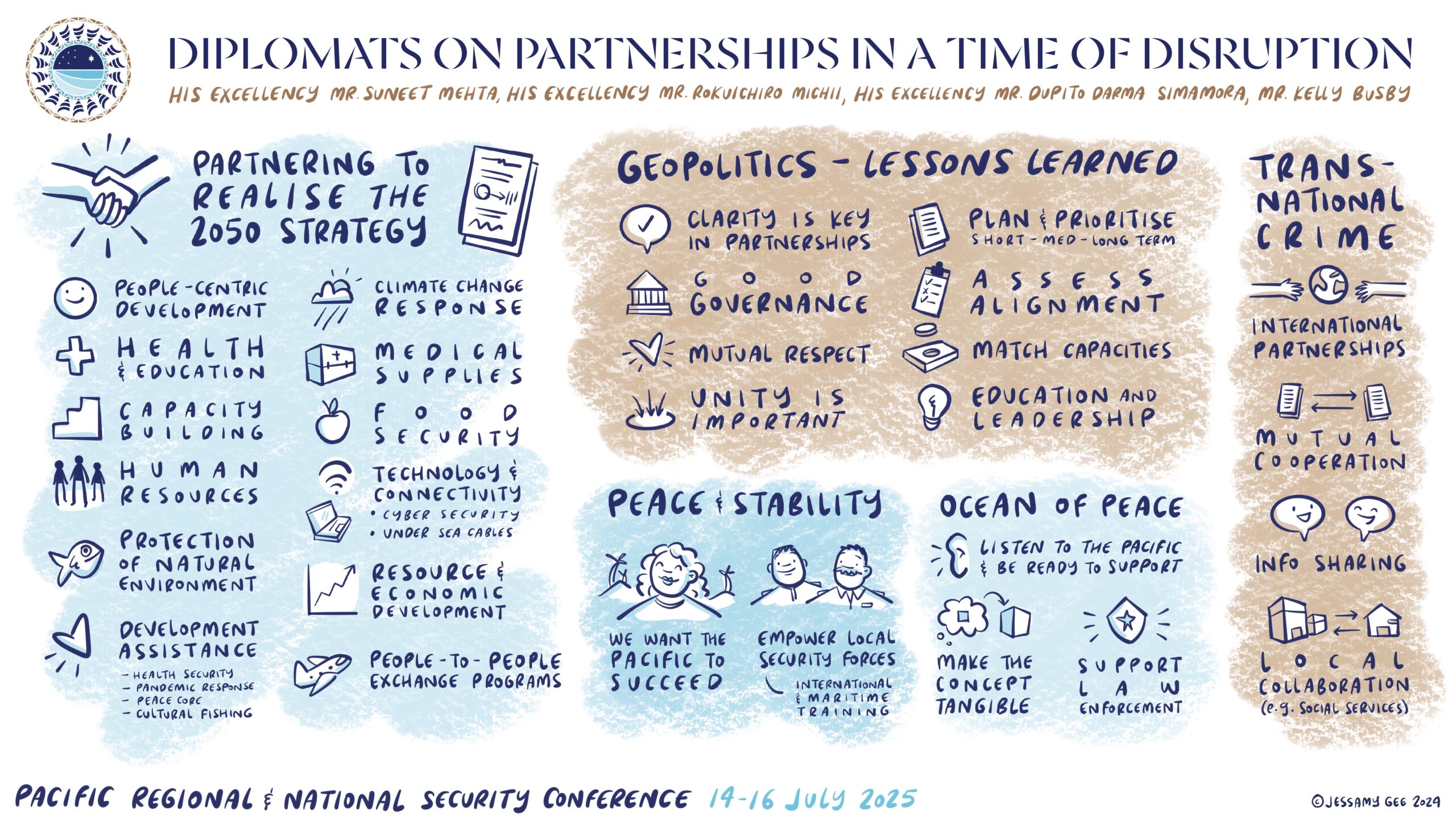
“Thanks so much for your work this week – it’s a wonderful Aide-Memoire!”
“Oh, yes. Thank you. It’s absolutely my pleasure.” I hadn’t heard the term before, but I got the gist. Not to brag but I took Year 9 French, sooo….
I almost allowed my ego and obvious natural linguistic prowess to let the phrase flow past us in conversation, but instead I paused.
“Sorry, I haven’t actually heard that term before – I mean, I can take a pretty good stab at what it means (PROWESS!)… But I’ve never heard it used.”
“Oh you haven’t? It’s an historic term used in diplomacy. It refers to an informal way of capturing and circulating a diplomatic message.”
Well hot damn gal, you’ve hit the nail on the head – an Aide-Memoire is precisely what I’m doing here.
———
Since 2017, I’ve been lucky enough to periodically spend time working with groups of politicians, diplomats, legislators, lawyers, academics, law enforcement and other experts from across the Pacific Islands looking to address concerns and opportunities of regional significance.
This work has also taken me across the world to the Council of Europe in Strasbourg to support their International Conference on Cybercrime.
This has been some of the most interesting and rewarding work of my career, and the most valuable to my clients.
Why?
- Dialogue across cultures – Diplomatic negotiations often involve people from different linguistic, cultural, and political backgrounds. Visuals can act as a “universal language,” bridging gaps where words alone might be misunderstood. At a conference like this English may be the common language, but it’ll be almost no one’s first language, so visuals act as an important context and comprehension tool.
- Neutrality – A graphic recorder is a neutral party, capturing a transparent account of the conversation. One that is non-verbatim but captures essence, emotion, and intent. This can help reduce misinterpretation and demonstrate fairness in documenting what was said, which helps to build trust.
- Supporting complexity – A visual record can help make complex systems, shared goals and differences visible, and provide a “big picture” reference point during long, multi-day engagements.
- Memory & Legacy – Diplomacy often creates documents of record – treaties, reports, communiqués, resolutions. Graphic recordings can supplement these with more human, memorable visuals. For example, capturing the spirit of a peace dialogue through images can later serve as a cultural artifact or educational resource, reminding participants of the why, not just the what.
- Public & Community Engagement – In contexts where diplomacy is shared with the public, graphic recording can make the outcomes more accessible, engaging, and shareable. It transforms “dry” policy discussions into something people can connect with emotionally (and actually want to read). It provides artifacts that use plain language along with the additional context and storytelling through images, making it easier for individual representatives to share outcomes with the public in their home nations.
In short: graphic recording can serve as a bridge, a mirror, and a memory in diplomacy — helping people see not only the words spoken but also the shared humanity behind them.
Jessamy Gee is the Director of Think in Colour, Founder & Founding President of Graphic Recorders Australia (2019 – 2022), and Australia’s first and only IFVP Institute Certified Master Visual Practitioner.